Chapter-7
Assistant Engineer (AEN), Dhanbad
It was 1969 and my first posting at a Divisional headquarters station. Dhanbad division was created in the recent past, carved out of Asansol division. Separate control for traction power was yet to be established. In the control room there was a chamber called ‘Officers table’ where the Branch officers assembled in the morning to discuss incidents affecting train movement. A separate control operated at Barkakana for the Central India Coalfield (CIC) section under the supervision of a DOS. Chopan was the farthest point of the division. The DS found it convenient to visit it via Dehri-On-Sone. The office of the Chief Mining Advisor, Railway Board, was close to the DS office. My office was a separate entity with exclusive staff and it functioned from a separate building.
I had a small section on the GC section but I was under frequent glare of the Divisional Superintendent (Sri S.N.Sachdev) because of accidents in the colliery sidings of DHN-Jharia-Patherdih (PEH) section and DHN-Katrasgarh(KTH)-Chandrapura (CRP) section. Some of them happened on the overaged track called upon to bear the load of BOX wagons. This affected Division’s performance in the matter of coal loading. One accident was derailment of a coal-loaded train bound for DHN, in which one wagon possessing a sharp-flanged wheel had cut into a worn-out tongue rail taking no road. Emerging from DHN station the tracks for PEH & CRP sections crossed each other in a Diamond crossing layout. The railway line to KTH passed close to the area of coal underground fire. KTH-Nichitpur link and Kusunda-Tetulmari links enabled movement of coal rakes to and from GC bypassing DHN. There was no passenger train service on the Pradhankhunta (PKA)-Patherdih (PEH) link. Sindri marshalling yard was served from Sindri B.H. on this line. Recently passenger train service was introduced on the PP link giving connectivity to Sindri town & Bhojudih (via Sudamdih). Track on the GC was tested by the Track-recording-car and On branch lines by Hallade track recorder.
The steam loco shed at DHN-It existed for servicing engines operating in the non-electrified DHN-CRP and DHN-PEH sections as also the colliery sidings accessed through them including Dugda coal washery. Mostly HT class of 2-8-2 tank locos built by Beyer Peacock of Manchester in 1923 were allocated to this shed. It was also home to an ART .The loco-footoverbridge of 1880 located at the site of old DHN station and laid with wooden-planks on its walkway had outlived its life. The Zonal Training School (ZTS), Bhuli was conveniently approachable during push trolley inspection of the G.C. section. A visit to it was sometimes for inspection and on other occasions for delivering lectures to the trainee IOWs and PWIs. There was a Safety camp near the station for counselling of the traffic staff. The railway stadium opposite the VIP platform was impressive. The bungalow allotted to me was modest and remembered for its BAIL (Stone fruit) tree. It was not far from the quarters no ‘36, Pathar Kothi’ which my father-in-law occupied, while he was TI /DHN in the fifties. The Divisional hospital had supportive and friendly staff and was moderately equipped to dea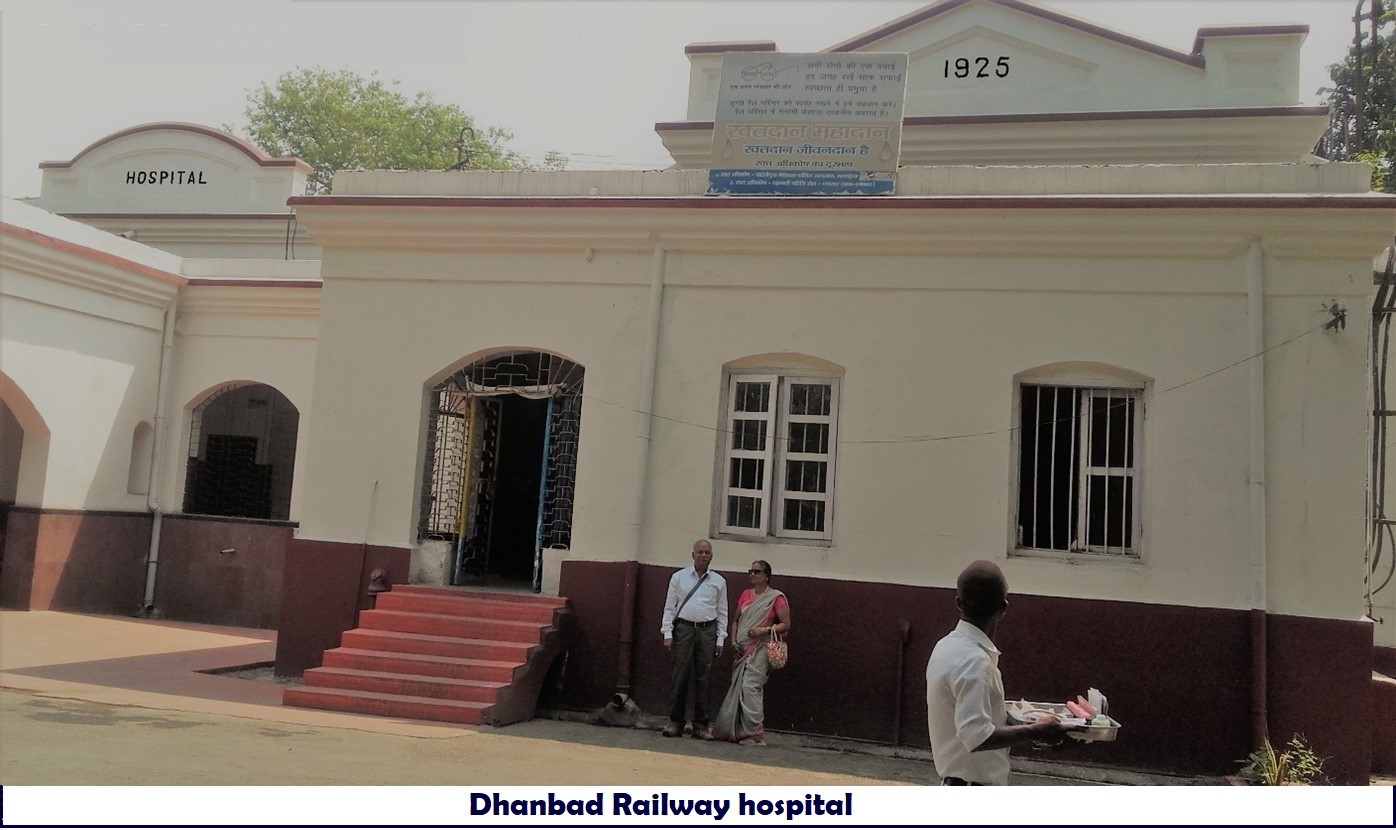 l with routine cases.
Water supply- The sources of water were two ground reservoirs viz Upper Matkuria & Lower Matkuria and 3 number of open wells. The water from them was pumped to the Filter plant for filtration by Rapid-gravity-sand-filter .Some water came from the town supply also on payment. Availability of water during summer became acute due to depletion of water level .It necessitated cutting of channels in the bed of Katri river for tapping water where a well was provided.
There used to be orderly officer duty once in a month at DHN station for addressing passengers’ grievances. There was no direct train to Patna. Slip coaches were run by 89 UP & 90 DN between DHN and GMO, for attachment to/detachment from Ranchi-Patna Exp.
During my tenure there was considerable staff unrest. Pressure groups like Loco running staff association, ASM association etc. were demanding additional perks & allowances and disrupting train movement on some pretext. Since the recognized unions (ERMC and ERMU) had lost sway over them, there was no scope of negotiations. The response from the state civil and police officials was lukewarm. We had to toil at stations clamping the points on the running lines for through movement of the trains without intervention of the station staff. Emergencies were opened manned by the officers at marshalling yards of PEH, KTH and Kusunda. With deterioration in situation, services of the territorial army was sought. from Ferozpur Division of the N.R.
The averted accident--We were motor-trolleying from Patherdih to Pradhankhanta (PKA). On arrival at PKA, the cabinman was informed of our intention to proceed to DHN. The points were set for the UP GC and a green flag waved. We proceeded and even checked a gang in the way unmindful of the Deluxe Express which was closing in on us. It is only when we entered Barmasia cutting, on approach of DHN, that the gangmen working on the adjacent line shouted and violently waved warning us of an impending danger. Brakes were applied and we jumped off the trolley. It was sheer luck that the train was stopped short of the trolley. A fatal accident was averted due to the presence of mind shown by the driver. The DS was apprised of it. During the informal enquiry the cabinman stated "I was against the trolley being taken to GC because Deluxe Express was due to arrive shortly. I even waved a red flag. But the Officers forcibly put the trolley on the GC''. We were stunned. The DS advised us against pressing for a formal enquiry. We had failed in our duty by not ascertaining the train position before putting the trolley on track. We were proceeding without ‘line clear’ or ‘train following’ as required under rules. There is a metal plate fixed on a FAIRMONT motor trolley which read “The best safety device known is a careful railwayman”. After a few days during footplate inspection, I happened to meet the driver of the Deluxe Express of that fateful day. He was J Greene, a stocky Anglo- Indian driver (GMO based) who knew me personally having met during footplate inspections on earlier occasions. He said " Sir, when I saw the motor trolley precariously ahead of my train, I instantaneously applied the brake and prayed to the Almighty that I should be able to stop the train short of the trolley. I am happy that I succeeded in it. When I saw you as one of the persons who had jumped off the trolley, I felt emotive. I bowed to my saviour.
Quality of track maintenance--The CE (Sri Kalicharan) was returning from M by 4 Down (Mumbai-Howrah mail). We met him on arrival of the train at DHN in the morning hours. After exchange of pleasantries the conversation went on like this:- The Divisional Engineer :-“ Sir, how was the running between Gaya and Dhanbad ?” The Chief Engineer :- “ can not say. I was sleeping.” The DEN;-“ Sir, You could sleep; that means the running was good. Thank you, Sir.”
The leading stanchion-- The Prime Minister was to come to Chandrapura in a special train from Ranchi (RNC) to inaugurate a unit of the Bokaro thermal power station. CRP had a low level platform. It was necessary that a wooden step of suitable design should be made to enable the PM to detrain from the saloon comfortably. It was ensured in this way. At RNC height of the saloon floor above the rail was measured. At CRP, height of the platform above the rail was measured. This is how the height of the steps was calculated. Steam locos have two stanchions (tubular structures on the two sides of the entry which the drivers often hold). The horizontal distance between the leading stanchion of the loco and the centre line of the saloon door was recorded at Ranchi using steel tape and relayed to the officials at CRP . Here a suitable place was selected for placing the steps. The distance of the leading stanchion was marked on the platform and the STOP board erected. The driver had the instructions to stop the train so that the leading stanchion is plumb with STOP board. Officers of Engg and mechanical departments were on footplate to ensure it. Things went as planned. As soon as the train stopped, the PM lost no time in getting the saloon door opened and was happy to find a decorated step waiting at the saloon door. From this post, I was promoted to senior scale and transferred to Danapur. Farewell was accorded to me in a small function which was graced by the DS (Sri A.K.Mukherjee) , the DEN (Sri S.N.Kashyap),my inspectors and the office staff.
